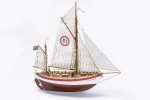
Scale: 1:45
Length: 725 mm | Width: 295 mm | Height: 665 mm
Difficulty: medium
Description
From the early 16th century, European powers attempted to find the Arctic sea route. During Roald Amundsen's expedition, the Gjøa did not simply sail — it measured, tested and redefined the world's understanding of the Arctic.
Amundsen's team spent two years studying terrestrial magnetism and precisely locating the Magnetic North Pole — a key step in understanding why compass needles do not always point to the same place.
The Magnetic North Pole is the north that compasses point to, because it is the location where the Earth's magnetic field pulls downward.
Unlike the great ships of the era, the Gjøa did not rely on force. It relied on intelligence, adaptation, and an extraordinary ability to read its environment.
Purpose
With the Gjøa, OcCre adds a model of unique historical and symbolic value to its collection — not only for the feat it represents, but for its role in the evolution of scientific exploration and navigation.
The build experience
Building the Gjøa model is reliving the path Roald Amundsen chose. It means advancing step by step through a story where every decision made the difference between failure and changing history forever.
OcCre brings the Gjøa into its polar collection alongside the Fram — the two most famous polar ships in the world. The same explorer. The same museum in Oslo.
At OcCre, we want you to be part of the moment when exploration stopped being about force — and became about understanding.
Materials
Every component is designed with precision and historical fidelity, delivering a build experience that combines technical challenge, fine detail, and craftsmanship.
Lime wood
Walnut wood
Brass
Cotton
Technical specifications
Difficulty: Intermediate
A model that challenges you to think, interpret and build with the
same logic Roald Amundsen used to change history. A model that
will push your limits and take your craft to the next level.
Scale Length Width Height
1/45 725 mm 295 mm 665 mm
Estimated build time: approx. 480 hours
Number of parts: 1991
Kit contents
Building the Gjøa is learning to read a heading. A model built not
on force, but on precision, observation, and the ability to
understand every step.
The kit includes:
Step-by-step assembly instructions
Video tutorials
Scale plans
Cast metal and brass fittings
Laser-cut plywood sheets
Lime, African walnut and sapele wood strips
Hand-sewn sails
The Gjøa was the first ship to navigate the Northwest Passage through the Arctic Ocean. The expedition, led by Roald Amundsen, departed Oslo in 1903 and arrived at San Francisco Bay in 1906.
With this release, OcCre adds a unique piece to its polar collection — the vessel with which Roald Amundsen completed the Northwest Passage and redefined the way the world orients itself.
The Gjøa was not built for glory. It was built to endure, adapt and understand. A fishing boat turned protagonist of one of the greatest feats in the history of exploration.
Building the Gjøa is more than a modelling challenge. It is understanding that when north is not fixed, moving forward is not enough. You have to know how to read the heading.
A model that turns every part into a decision, every step forward into a deeper form of understanding.
Image gallery
The Gjøa represents the story of the vessel that achieved what no one had managed in over 300 years. It was not the largest. Not the strongest. It was the one that understood something the others could not read.
While the great powers were sending entire expeditions that vanished into the Arctic, Roald Amundsen chose a different path — a small ship, six men, and a
fundamentally different way of facing the territory.
For nearly three years, the Gjøa did not simply advance. It stopped, observed, and turned the ice into a laboratory. It studied terrestrial magnetism, located the Magnetic North Pole, and demonstrated that a heading was not a fixed point — it was something that had to be understood.
Historical context
From the early 16th century, European powers attempted to find the Arctic sea route. Franklin (1845), Parry, Ross — all failed. Many died. The expedition departed Oslo on 16 June 1903 and arrived at San Francisco Bay on 19 October 1906.
The Gjøa is a Norwegian wooden-hulled sloop, originally built for fishing and seal hunting in Arctic Norwegian waters. While previous explorers sent warships, Amundsen deliberately chose the Gjøa because in shallow, ice filled waters, size is a handicap. Its draught was just 0.99 metres — shallow enough to navigate channels where any frigate would have run aground.
The expedition spent two winters (1903–1905) in the bay of King William Island — a place the Inuit called Uqsuqtuuk, which Amundsen named Gjoa Haven, in honour of the sloop. There, the crew located the Magnetic North Pole at 70°30′N 95°30′W.
The Gjøa departed Gjoa Haven on 13 August 1905, reached Cambridge Bay on 17 August, and completed the Northwest Passage. On 26 August, they spotted an American whaling vessel approaching from the west — the first ship they had seen from the outside world in years. Poor conditions forced one final winter at King Point, near the Mackenzie River delta. The Gjøa departed on 10 July 1906, crossed the Bering Strait on 24 August, was welcomed in Nome on 31 August, and arrived at San Francisco Bay on 19 October 1906.
The Gjøa at the Fram Museum
The Gjøa was the first ship to navigate the entire Northwest Passage. Roald Amundsen and his six companions achieved this between 1903 and 1906. Today, the Gjøa belongs to the Fram Museum in Oslo. A purpose built extension opened in 2013 to house the vessel, and it has been open to the public ever since.
Following decades of open-air display in San Francisco — subject to weathering, vandalism and deterioration — the Gjøa was repatriated to Norway. In 2017 it underwent a full
restoration. The Norwegian Directorate of Cultural Heritage stated: "Given the ship's history as the first to cross the Northwest Passage, it is of national interest that it be preserved as a maritime monument for future generations."
Together with the Fram, the Gjøa represents the heart of Norwegian polar history — and the centrepiece of one of Scandinavia's most visited maritime museums. For the OcCre collector, owning both models is building that museum's defining display at home.